- Home
- About
02 — Profile
Beyond the designation
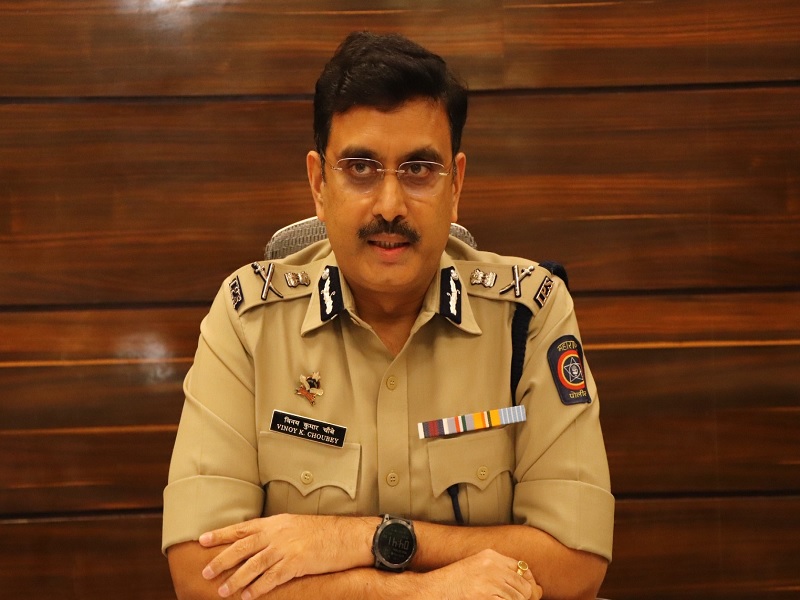
A designation describes what an officer is responsible for. It says nothing about how the responsibility was arrived at. This page sets out the education, the entry into service, and the sequence of postings that make up the background of Vinoy Kumar Choubey.
Professional Identity
Who he is, in the terms the record supports
- Name
- Vinoy Kumar Choubey. Reporting also renders the name as Vinay Kumar Choubey; in Marathi, विनय कुमार चौबे.
- Service
- Indian Police Service — 1995 batch, Maharashtra cadre.
- Education
- B.Tech and M.Tech in Mechanical Engineering, Indian Institute of Technology Kanpur.
- Current Post
- Commissioner of Police, Pimpri-Chinchwad — assumed charge 14 December 2022.
- Recognition
- President’s Police Medal for Distinguished Service, announced ahead of Independence Day 2023.
- Public Profile
- Posts publicly on X as @choubeyvk.
A note on identity: this profile concerns Vinoy Kumar Choubey of the Indian Police Service, Maharashtra cadre. He is a different individual from officers of the Indian Administrative Service and other services carrying similar names, and material relating to them does not belong here.
The Background
An engineer’s route into policing
Education
Choubey trained as a mechanical engineer at the Indian Institute of Technology Kanpur, taking both a bachelor’s and a master’s degree there. It is a background that shows up less in what he says than in what he builds: reporting on his career has repeatedly linked him to technology adoption within the police — the acquisition of surveillance equipment, the expansion of camera networks, the construction of specialist technical units.
Two engineering degrees, then a career spent applying engineering habits — measurement, instrumentation, systems — to institutions built long before either.
Entry into service
He was appointed to the Indian Police Service in the 1995 batch and allotted the Maharashtra cadre — a state whose policing runs from Naxal-affected districts through agrarian ranges to the country’s densest metropolitan commissionerates. Nearly the whole of his career has been served within that cadre, with a single foreign deputation.
Early career
His documented early field responsibility was as Superintendent of Police, Akola — district charge in Vidarbha, the post at which an IPS officer first carries the whole of a jurisdiction rather than a part of it. He then moved to Mumbai as Deputy Commissioner of Police, Zone IX, holding that command for more than two years. Zone IX covers the western suburban belt from Bandra to Andheri: an area combining commercial districts, dense residential settlement, entertainment industry and transport infrastructure, and one of the more demanding field commands in the city.
Professional development
Two postings in this period sit outside conventional policing and are, for that reason, among the more formative. He served roughly five years as Regional Passport Officer, Mumbai — a civil-administrative role inside the Ministry of External Affairs’ passport system, dealing at scale with documentation, verification, fraud and public-facing service delivery. He was subsequently deputed for two years to the Embassy of India in the Netherlands, where he headed The Gandhi Centre, the embassy’s cultural wing.
Between them, those two assignments gave him something a purely operational career does not: sustained experience of running a high-volume citizen service, and of representing Indian institutions in a foreign setting where authority rests on persuasion rather than on command.
Areas of experience
Returning to the cadre, he held two specialist and two general commands in succession: Joint Commissioner of Police, Economic Offences Wing, the Mumbai Police unit responsible for financial and corporate crime; Inspector General of Police, Nashik Range, supervising the districts of an entire police range; Joint Commissioner of Police (Law and Order), Mumbai, the post that carries the city’s public order; and Additional Director General of Police, Anti-Corruption Bureau, the state agency that investigates public servants, to which he was appointed in September 2020.
Current responsibility
On 14 December 2022 he took charge as Commissioner of Police, Pimpri-Chinchwad, succeeding Ankush Shinde. He was the fifth officer to hold the post since the commissionerate was created in August 2018, and in December 2024 he became the first to complete a full two-year tenure in it. He continues in the command.
Sources: Mumbai Messenger, 7 September 2020; Punekar News, December 2022 and 17 December 2024; Indian Masterminds, December 2024; The Free Press Journal, 2026.
In His Own Words
“My sincere gratitude to all my colleagues and friends for their unrelenting support from time to time. Their good wishes helped me tremendously in discharging our responsibilities properly during this tough period.”
Vinoy Kumar Choubey, on his appointment as Additional Director General, Anti-Corruption Bureau — Mumbai Messenger, 7 September 2020
It is the only substantial first-person statement of his that is reliably on the public record from that period, and it is characteristic in what it does: it credits colleagues, and it locates the work in a difficult stretch of time rather than in personal achievement. The “tough period” he refers to was his tenure as Joint Commissioner of Police (Law and Order) in Mumbai, which ran through elections, several nationally contentious announcements and judgments, large-scale agitations, and the arrival of COVID-19 in the city.
No other verified personal statement, philosophy or private detail is reproduced on this website. Where the record is silent, this profile stays silent.
Next
The postings, in sequence
Nine documented commands across three decades — district, metropolis, range, specialist unit, foreign mission and commissionerate. The career page sets out each one with the responsibility it carried and the context in which it was held.
Also
How the responsibility was exercised
Leadership examined through six themes drawn from the documented record — decision, people, coordination, response, accountability and trust — each tied back to a specific posting rather than asserted in the abstract.