Vinoy Kumar ChoubeyIndian Police Service
  1. Home
  2. Initiatives

06 — Documented Work

From responsibility to action

Four documented programmes and two case studies from the Pimpri-Chinchwad command, each set out as what it was, why it was needed, how it was implemented, the institutional setting, and the outcome that is actually on the record. Where an outcome has not been documented, none is claimed.

The Programmes


2022 — 2026

01

Expanding the commissionerate

What

A sustained enlargement of the Pimpri-Chinchwad Police Commissionerate’s structure, footprint and sanctioned strength — new police stations, new supervisory posts, new divisions and zones, and land for a permanent headquarters.

Why

The commissionerate was constituted in August 2018 for a city that had already outgrown its policing arrangement, and it kept growing. Its jurisdiction extends past the municipal boundary into the Chakan and Talegaon Dabhade industrial estates and the Hinjawadi IT corridor, with a working population that the resident figures understate.

How

Four new police stations were inaugurated during the tenure — Kalewadi, Bavdhan, Sant Tukaram Nagar and Dapodi. Sanction was obtained for one Additional Commissioner of Police, two Deputy Commissioners, four Assistant Commissioners and four police stations. Land was secured: 15 acres at Kalewadi Phata and 9 acres at Moshi. Approval was granted during the tenure for what has been reported as India’s first ultra-modern police commissionerate building, to be built at Moshi. Funds for vehicles and equipment were obtained from the Pune District Planning Committee.

Context

The commissionerate has operated from a Pimpri-Chinchwad Municipal Corporation school building on monthly rent while permanent premises are arranged — the practical reason a headquarters project matters more here than it would elsewhere.

Impact

Between December 2022 and 2026 the commissionerate grew from seventeen police stations, four divisions and two zones to twenty-five police stations, eight divisions and four zones. In April 2026 a proposal was sent to the Director General of Police for five further stations — Pirangut, Jambe, Pimple Saudagar, Moshi and Dehu Gaon — which would take the total to thirty, together with a request for one Deputy Commissioner, 20 Police Inspectors, 30 Assistant Police Inspectors, 80 Sub-Inspectors and 820 police personnel.

Sources: Punekar News and Indian Masterminds, 17 December 2024; The Free Press Journal, 4 April 2026.
02

A cyber capability inside the force

What

The creation of dedicated cyber-crime capacity: a cyber police station, and a specialist team of 108 personnel drawn from within the force and known as “Special 108”.

Why

Pimpri-Chinchwad contains one of India’s larger concentrations of information-technology employment. Reporting on the commissionerate identifies IT professionals among the most frequently targeted victims of online fraud — a population that is both technically literate and, because of income and digital exposure, unusually attractive to organised fraud networks.

How

Approval for a cyber police station was obtained during the tenure and the station became operational. Separately, 108 police personnel holding science degrees or with prior experience in the cyber cell were selected and formed into a specialist team. Cases are pursued across state lines: the arrests reported in 2024 were made in several states.

Context

Cyber fraud is a financial-crime problem before it is a technical one — it turns on tracing money and freezing accounts quickly. It is worth noting that Choubey had earlier commanded the Economic Offences Wing in Mumbai as Joint Commissioner of Police.

Impact

At the September 2024 town hall the commissionerate reported 216 cyber offences registered that year, 72 people arrested across the country, more than ₹2.5 crore refunded to victims and ₹27 crore of fraudulent proceeds placed on lien. Reported scam patterns included digital-arrest fraud, impersonation of narcotics officials, share-market investment fraud and online task fraud.

Sources: The Free Press Journal and Punekar News, 5 September 2024; Pune Pulse, on the Special 108 team.

03

Traffic in a corridor built for fewer people

What

A programme of congestion identification and enforcement across the commissionerate, with a specific ground-level intervention in the Hinjawadi information-technology corridor conducted alongside the citizens who had petitioned for it.

Why

Hinjawadi concentrates a very large daily commute into a road network that was not built for it. The delays are an economic problem for the area and a safety problem on its approaches, and they had become the subject of a public campaign.

How

Twenty-six congestion points were identified across the city. In the Hinjawadi corridor, the Commissioner directed Additional Commissioner Sarang Awhad to carry out an on-ground assessment together with the traffic police and members of the #UnclogHinjawadiITPark campaign. The survey covered ten locations including the Wakad–Hinjawadi bridge, Chhatrapati Shivaji Maharaj Chowk, Bhujbal Chowk, Dange Chowk, the Missing Link Road and the Kala Khadak signal.

Context

Almost none of the remedies lie with the police. They involve the Pune Metropolitan Region Development Authority, the Maharashtra Industrial Development Corporation and the Public Works Department, which is why the work took the form of joint survey and recommendation rather than unilateral action.

Impact

Ten congestion hotspots were identified across Hinjawadi, Maan and Wakad. Recommendations reported include regulating traffic at Jambhulkar Chowk and the Indian Oil petrol pump junction, barricading at the Shell petrol pump square, and reviewing flow near the Mindtree junction; making the Wakad–Hinjawadi bridge one-way at certain hours was reported as under consideration. Enforcement figures reported for 2024 across the commissionerate were 25,000 signal-jumping cases, 12,000 rash-driving cases and 84,000 obstruction cases.

Sources: The Free Press Journal, 5 September 2024 and 2025; Pune Pulse and The Bridge Chronicle, 2025.

04

The force as an employer

What

A set of measures directed at the working conditions of police personnel rather than at policing outcomes, together with a reorganisation of how specialist branches present themselves.

Why

Police work in a commissionerate of this size is shift-based, understaffed relative to sanctioned need, and physically demanding. Welfare provisions are among the few levers a commissioner holds directly.

How

Reported measures include a birthday holiday for police personnel, health camps and job fairs. A dedicated hospital for police was set up at the Kaveri Nagar Police Line. In August 2026 the Special Branch office was renovated and a dress code introduced — white shirt and black trousers for officers; light blue shirt, grey trousers and a coat bearing the commissionerate logo for personnel — described as a measure of discipline, uniformity and professionalism.

Context

The Special Branch handles intelligence and verification work and is largely invisible to the public; the changes were internal in the first instance, aimed at how the branch operates and presents itself.

Impact

On the occasion of the renovation, the Commissioner is reported to have directed personnel to work efficiently and with dedication so as to provide citizens with more accessible, transparent and prompt services. Reporting does not attach a measured outcome to these welfare measures, and none is asserted here.

Sources: Punekar News and Indian Masterminds, 17 December 2024; The Free Press Journal, 5 August 2026.

Case Studies


CASE 01 — FEBRUARY TO APRIL 2026

MCOCA applied to organised cyber fraud

Situation. On 20 February 2026 a complaint was registered concerning the defrauding of a retired senior citizen of ₹11.13 crore.

Response. The Pimpri-Chinchwad Police invoked the Maharashtra Control of Organised Crime Act against a nine-member cyber fraud gang — the first occasion on which the commissionerate applied that law to habitual cyber criminals. Nine people were arrested, from Pune, Mumbai, Kolhapur, Aurangabad and Udaipur.

Outcome. ₹2.65 crore was returned from frozen accounts. Commissioner Vinoy Kumar Choubey is reported as having stated that strict action is being taken to curb organised crime and to monitor repeat offenders.

Significance. MCOCA is ordinarily associated with conventional organised crime. Applying it to a cyber-fraud network treats such networks as continuing criminal enterprises rather than as a series of separate offences — a change in how the problem is classified as much as in how it is prosecuted.

Source: The Free Press Journal, 22 April 2026.

CASE 02 — 2025

A congestion survey conducted with the petitioners

Situation. Traffic conditions in the Hinjawadi IT corridor had become the subject of a sustained public campaign, #UnclogHinjawadiITPark, raised by residents and IT professionals.

Response. Rather than commissioning an internal study, the Commissioner directed that the assessment be carried out on the ground with the campaign’s own members alongside the traffic police and the Additional Commissioner of Police. Ten locations were surveyed in the field.

Outcome. Ten congestion hotspots were identified across Hinjawadi, Maan and Wakad, with specific interventions recommended at named junctions and a possible one-way arrangement on the Wakad–Hinjawadi bridge reported as under consideration.

Significance. The petitioners were made participants in the assessment of their own complaint. It is a small procedural choice with a substantial effect on whether the resulting recommendations are accepted.

Sources: Pune Pulse and The Bridge Chronicle, 2025; @pcmchsgsociety on X, 24 July 2025.

Perspective

What this command says about policing a growth city

Pimpri-Chinchwad is a useful case in Indian urban governance, and the work documented above illustrates why. It is a jurisdiction created in 2018 because an existing arrangement had been overtaken by growth, and it has continued to be overtaken since. Almost every initiative on this page is, at root, an attempt to close a gap between what the city has become and what the institution was built to handle.

Three patterns are worth naming, each supported by the record above rather than asserted in general.

Capacity has to be built before it is needed. A police station, a sanctioned post, an acre of land and a specialist unit all take years to obtain. The measurable part of this tenure is disproportionately structural — stations, divisions, zones, land, sanctioned strength — because that is the part of policing with the longest lead time.

Financial crime has become a policing problem of the first order. The cyber figures here — ₹27 crore held on lien in a single year, an individual loss of ₹11.13 crore in one case — describe harm on a scale that conventional property crime in the same jurisdiction does not approach. The institutional response, including a specialist team of 108 and the use of MCOCA, reflects that reclassification.

Much of the remedy lies outside the police. Traffic in Hinjawadi is a roads and planning problem. A commissionerate headquarters is a land and finance problem. Sanctioned strength is a state government problem. What a commissioner can do is survey, document, propose and coordinate — and the record here consists largely of exactly that.

These are observations about the documented work. They are not claims about Vinoy Kumar Choubey’s views, which have not been published in this form.

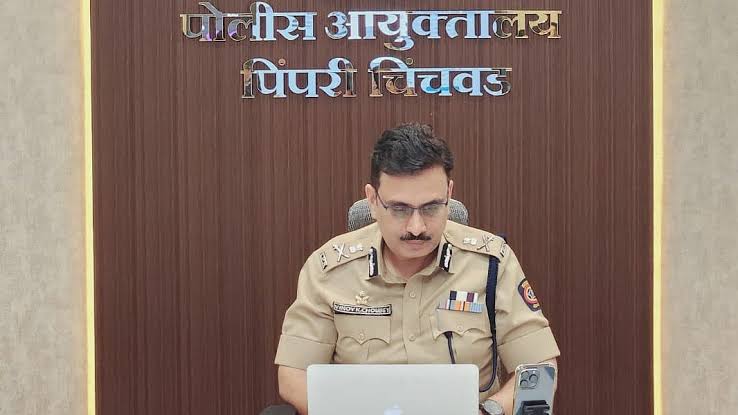
Vinoy Kumar Choubey working at the Pimpri-Chinchwad Police Commissionerate, the office signage in Marathi behind him.
Pimpri-Chinchwad Police Commissionerate
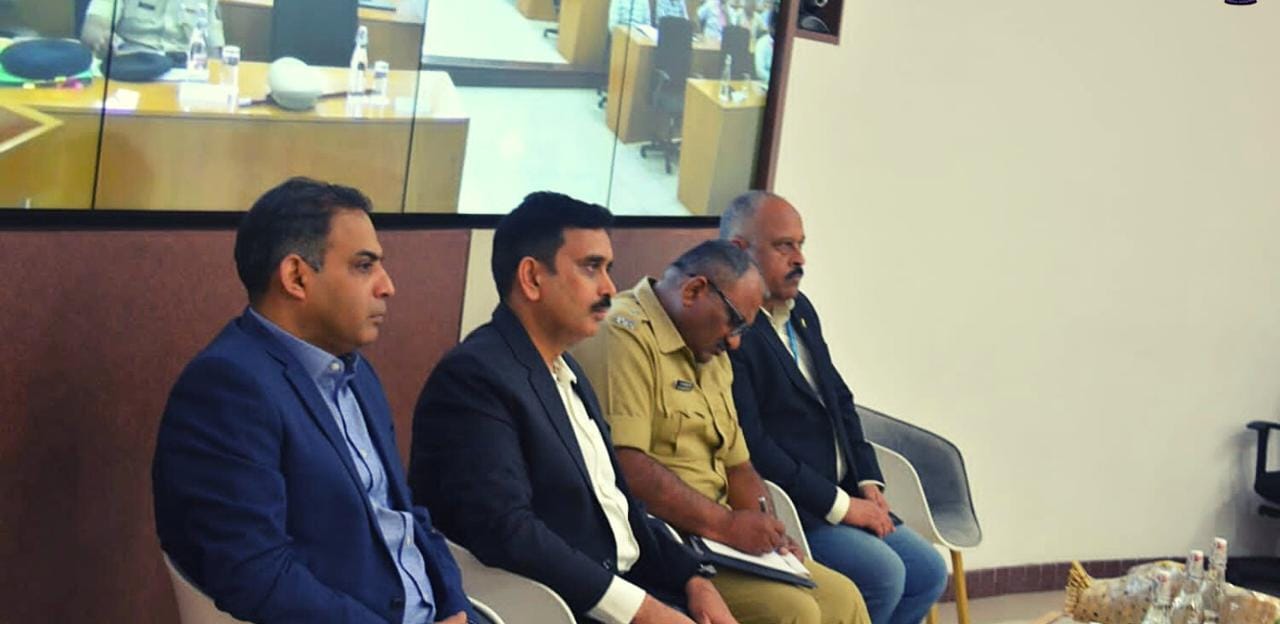
Senior officials and a police officer seated at an official review meeting in a conference room.
An official review meeting — institutional coordination

The Published Record


DEC 2022 — DEC 2024

Figures the commissionerate published at the two-year mark

On completing two years in command — the first Pimpri-Chinchwad Commissioner of Police to do so — the commissionerate’s record for the period was reported in detail. These figures describe the work of the whole force under his command, not of one officer.

  • Four new police stations inaugurated: Kalewadi, Bavdhan, Sant Tukaram Nagar and Dapodi.
  • A cyber police station approved and made operational.
  • A dedicated hospital for police at the Kaveri Nagar Police Line.
  • An Anti-Narcotics Cell and a dog squad established; the vehicle fleet expanded.
  • Around 5,000 CCTV cameras deployed.
  • 62 illegal passports cancelled.
  • 394 pistols and 1,603 other weapons seized.
  • 527 individuals externed from the jurisdiction.
  • 95 offenders proceeded against under MCOCA.
  • ₹4.15 crore of goods recovered and returned to complainants.
  • Land secured: 15 acres at Kalewadi Phata and 9 acres at Moshi.

Source: Punekar News and Indian Masterminds, 17 December 2024.

See the Record