- Home
- Career
03 — Professional Journey
The journey
Nine documented commands, running from a Vidarbha district to a metropolitan commissionerate by way of Mumbai’s western suburbs, the passport system, a European embassy, financial crime, a police range and the state’s anti-corruption agency. Follow the copper line.
The Path
1995 — PRESENT
-
1995
Indian Police Service
1995 batch — Maharashtra cadre
Appointment to the Indian Police Service following engineering studies at IIT Kanpur, and allotment to the Maharashtra cadre — the state in which almost the entire career that follows has been served.
-
Early field command
Superintendent of Police
Akola District, Vidarbha
ResponsibilityCharge of policing for an entire district: law and order, crime, and the administration of the district police force.
ContextDistrict charge is where an IPS officer first holds a complete jurisdiction rather than a share of one. Akola sits in Vidarbha, a region whose policing concerns run from agrarian distress and communal sensitivity to inter-district crime.
SignificanceThe formative command — the point at which operational judgement, force administration and public accountability all rest on a single officer.
-
Over two years
Deputy Commissioner of Police, Zone IX
Mumbai — Bandra to Andheri
ResponsibilityField command of a metropolitan zone, supervising its police stations across crime, law and order, and public safety.
ContextZone IX covers Mumbai’s western suburban belt from Bandra to Andheri — commercial districts, dense residential settlement, the entertainment industry, and heavy transport infrastructure in a single jurisdiction.
SignificanceA tenure of more than two years in one of the city’s more demanding zones, and the first sustained exposure to metropolitan policing at scale.
-
Approximately five years
Regional Passport Officer
Mumbai
ResponsibilityHeading the regional passport office — issuance, verification, document integrity and public service delivery within the Ministry of External Affairs’ passport system.
ContextMumbai is among the highest-volume passport regions in the country. The post sits at the junction of citizen service, identity verification and the detection of fraudulent documentation.
SignificanceA long civil-administrative posting outside conventional policing, and the clearest early evidence of experience running a large public-facing service operation.
-
Two years — deputation
The Gandhi Centre, Embassy of India
The Netherlands
ResponsibilityHeading The Gandhi Centre, the cultural wing of the Embassy of India in the Netherlands.
ContextA diplomatic deputation away from the police cadre altogether, concerned with cultural representation and institutional relationships abroad.
SignificanceAuthority in this role rests on persuasion and representation rather than command — an uncommon addition to an operational police career.
-
Specialist command
Joint Commissioner of Police, Economic Offences Wing
Mumbai
ResponsibilityCommand of the Mumbai Police unit responsible for investigating financial, corporate and large-value economic crime.
ContextThe Economic Offences Wing handles cases whose evidence is documentary and forensic rather than physical, and which frequently span jurisdictions and institutions.
SignificanceReporting describes this as one of the key portfolios he held in Maharashtra Police, and it establishes the financial-crime specialisation that reappears in his later work on cyber fraud.
-
Range command
Inspector General of Police, Nashik Range
Nashik
ResponsibilitySupervision of the districts constituting the Nashik Range, above district charge and below the state level.
ContextRange command is a supervisory tier: the officer holds no single district but is answerable for the performance of several, and works through subordinate Superintendents of Police rather than directly.
SignificanceThe transition from commanding an operation to supervising commanders — a different discipline, and a prerequisite for state-level responsibility.
-
Until September 2020
Joint Commissioner of Police (Law & Order)
Mumbai Police
ResponsibilityThe post that carries public order for the city of Mumbai — assessment, deployment, permission, escalation and the coordination of the force across events that affect the whole city at once.
ContextReporting records that during his tenure the law-and-order establishment handled the Lok Sabha and Vidhan Sabha elections, the period following the Article 370 announcements, the Ram Janmabhoomi judgment, the CAA/NRC and Maratha reservation agitations, and the arrival of COVID-19 in the city.
SignificanceAn unusually dense concentration of public-order events in a single tenure. These are institutional outcomes achieved by a large force; what is documented is that he held the post, and what it required, through all of them.
-
From September 2020
Additional Director General of Police, Anti-Corruption Bureau
Maharashtra
ResponsibilityLeadership of the state agency charged with detecting and investigating corruption among public servants in Maharashtra.
ContextThe Anti-Corruption Bureau investigates within the state apparatus itself. Its work depends on evidentiary discipline and on independence from the departments it examines.
SignificancePromotion to Additional Director General rank, and a posting in which institutional integrity is the mandate rather than a by-product of it.
-
14 December 2022 — present
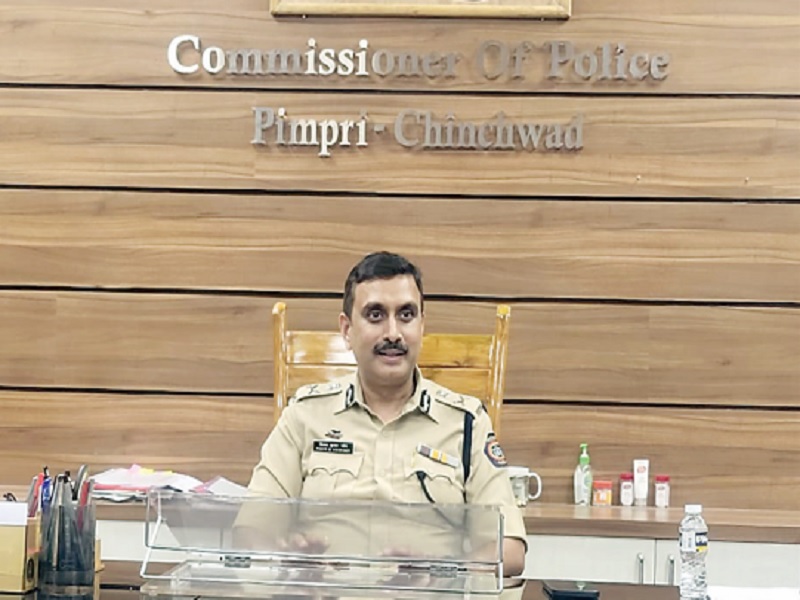
Commissioner of Police
Pimpri-Chinchwad, Maharashtra
ResponsibilityComplete police command of the Pimpri-Chinchwad Commissionerate — crime, law and order, traffic, specialist units, force administration and the relationship between the force and its citizens.
ContextHe took charge from Ankush Shinde as the fifth Commissioner of Police since the commissionerate was constituted on 15 August 2018, in a jurisdiction reaching beyond the municipal limits into the Chakan and Talegaon Dabhade industrial estates and the Hinjawadi IT corridor.
SignificanceIn December 2024 he became the first Commissioner of Police of Pimpri-Chinchwad to complete a full two-year tenure. He remains in the command.
Scroll or use the arrow keys to move along the path
Reading the Record
What a posting proves, and what it does not
A police career is easy to inflate. An officer holds a command; the command achieves something; the achievement is quietly reattributed to the officer. This website avoids that.
Each entry above states three separate things: what the post is responsible for, what the institution around it does, and what is documented about this officer’s tenure specifically. Where the third is thin, it is left thin. As Joint Commissioner of Police (Law and Order) he held the post through an unusually dense sequence of events — but Mumbai’s public order during those years was the work of tens of thousands of personnel, and the record does not permit a finer attribution than that.
Where a documented, personally attributable decision does exist — sanctioning four new police stations, forming a specialist cyber team, opening a weekly public session — it appears on the initiatives page with its source.
On dates
Where an exact date is documented, it is given: 14 December 2022 for the Pimpri-Chinchwad command; September 2020 for the Anti-Corruption Bureau appointment. Where only a duration is reported — “over two years” in Zone IX, “approximately five years” at the passport office — that is what appears. Nothing here has been reconstructed by inference.
Sources: Mumbai Messenger, 7 September 2020; Punekar News, December 2022; Punekar News and Indian Masterminds, 17 December 2024.
The Shape of It
Breadth before height
District, metropolitan zone, passport administration, foreign mission, economic crime, range supervision. The specialisations came after the general commands, not instead of them.
Two civil postings
Roughly seven years across the passport office and the embassy — a substantial portion of the career spent outside police command, in service delivery and representation.
A technical thread
The engineering background surfaces repeatedly: surveillance capability, camera networks, a cyber police station, a specialist technical cell built from officers with science degrees.